


Table of Contents
- Why Breathable Fabrics Matter for Tropical Streetwear
- Best Fabrics for Hot Weather: A Comparison
- Cotton vs Linen for Hot Weather: Which Wins?
- Moisture-Wicking Fabrics for Hot Weather: How They Work
- Fabric Weight, Weave, and Breathability Ratings
- How to Care for Lightweight Clothing in Humidity
- Choosing Breathable Streetwear That Fits Your Style
- Conclusion
- Frequently Asked Questions
Last Updated: October 14, 2026
Why Breathable Fabrics Matter for Tropical Streetwear
Sri Lanka's coastal humidity sits above 75% for most of the year, and that single fact reshapes how streetwear should be built. When sweat can't evaporate, it sits against your skin, fabric clings, and a graphic tee that photographs well in an air-conditioned room becomes unbearable by noon. At 404Wear, we design for that reality rather than fighting it, because the best breathable fabrics for tropical streetwear are the ones that move heat and moisture away from your body while still holding a silhouette worth wearing.
Breathability is the ability of a fabric to let air and water vapour pass through it, which determines how quickly your body sheds heat in humid conditions. Two things drive it: fibre type and weave structure. A tight, dense knit traps air; a looser weave or a fibre that wicks moisture moves it out. According to the Textile Institute's technical guidance on fabric comfort, air permeability and moisture vapour transmission are the two measurable properties that predict how a garment feels in heat.
Below, we break down which fabrics actually work in tropical humidity, how they compare, and how to care for them so they survive more than one season.
Best Fabrics for Hot Weather: A Comparison
The best fabrics for hot weather fall into three families: cotton for everyday wear, linen for peak heat, and performance blends for sweat-heavy activity. Each has a different job, and picking the wrong one for the wrong context is the most common mistake we see.
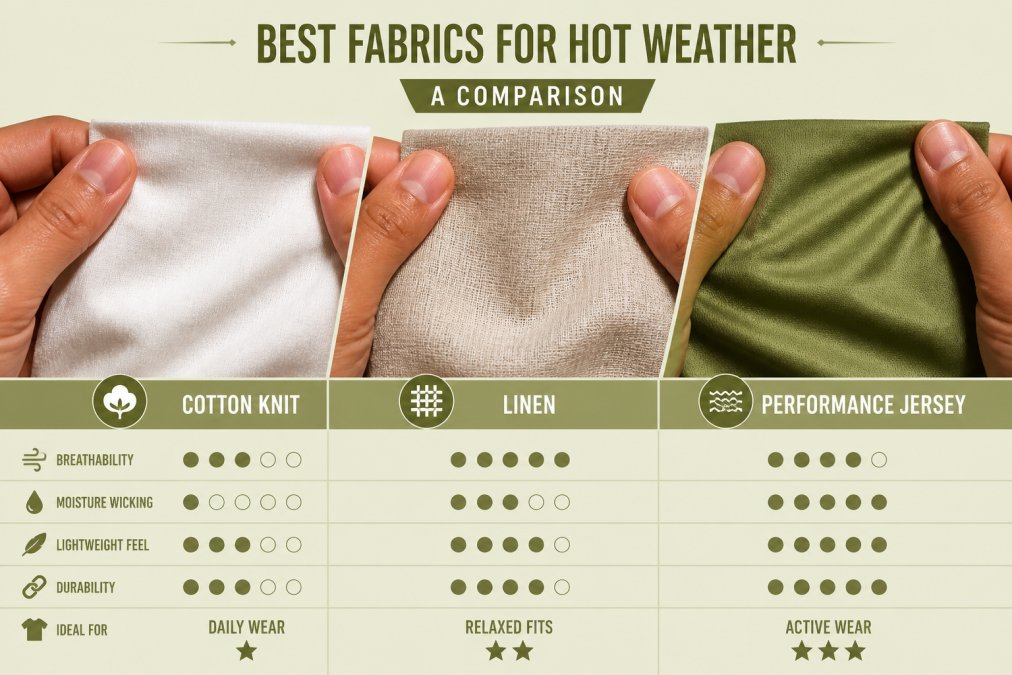
| Fabric | Breathability | Moisture Handling | Best For |
|---|---|---|---|
| Cotton | Moderate | Absorbs, dries slowly | Everyday tees, casual wear |
| Linen | High | Absorbs fast, dries fast | Peak heat, loose silhouettes |
| Performance blend | High | Wicks and moves sweat | Training, sport, active days |
Cotton: The Everyday Standard
Cotton is the default for a reason: it's soft, it takes print well, and it breathes when the knit is loose enough. A 220 gsm cotton-poly blend, like the one we use in our Gimme The Loot graphic tee, balances weight with airflow. Heavier cotton traps more heat, so in tropical humidity, mid-weight beats heavyweight almost every time.

The trade-off is drying speed. Cotton absorbs sweat and holds it, which is why a soaked tee stays damp for hours. For everyday wear that's fine. For a full day moving between outdoor heat and air conditioning, it's the weak point.
Linen: The Heat Specialist
Linen outperforms cotton in sustained heat because its fibre structure wicks and releases moisture faster. The trade-off is that it wrinkles, and it doesn't hold a sharp graphic print as cleanly. For loose, relaxed streetwear silhouettes, that's a feature, not a flaw.
Performance Blends: Engineered for Sweat
Performance blends are built to move sweat away from skin and spread it across the fabric surface so it evaporates faster. Our IMPACT HOOP LAB Reversible Training Top uses a lightweight, moisture-wicking performance fabric with an athletic fit, which is what you want when the day involves actual movement rather than standing around.

Cotton vs Linen for Hot Weather: Which Wins?
Linen wins on raw breathability and drying speed; cotton wins on durability, print quality, and everyday comfort. Neither is universally better, and the right answer depends on what you're doing that day.
If your priority is standing in direct sun for hours, linen's open weave and fast moisture release keep you cooler. If your priority is a graphic piece that survives repeated washing and keeps its shape, cotton or a cotton-poly blend is the safer bet.
What most guides miss is that the weave matters as much as the fibre. A loosely knit cotton breathes better than a tightly woven linen. When you're comparing two garments, look at the knit density before you look at the fibre label.
Moisture-Wicking Fabrics for Hot Weather: How They Work
Moisture-wicking fabrics for hot weather pull sweat off your skin through capillary action and spread it across the fabric surface, where it evaporates faster than it would sitting against your body. That's the entire mechanism, and it's why wicking fabrics feel dry while cotton feels clammy.
Wicking matters most when you're sweating heavily. For a casual day out, cotton's absorption is fine. For training or long walks in humidity, a wicking blend keeps you drier and reduces the chilled, damp feeling that comes with sweat-soaked cotton.
For a deeper look at how fibre and weave interact with heat, the Hohenstein Institute's research on textile comfort and humidity covers the testing methods behind breathability ratings.
Fabric Weight, Weave, and Breathability Ratings
Fabric weight, measured in grams per square metre (gsm), is the single most useful number on a garment tag for predicting tropical comfort. Lower gsm means lighter fabric and more airflow; higher gsm means more structure and more heat retention.
Weave structure matters just as much. An open knit lets air pass through; a tight weave blocks it. When a brand lists a breathability rating, it's usually measuring air permeability, and higher numbers mean more airflow. If no rating is listed, use gsm as your proxy: under 200 gsm for peak heat, 200-240 gsm for everyday wear, and above 260 gsm only for cooler evenings or air-conditioned spaces.
How to Care for Lightweight Clothing in Humidity
Lightweight clothing in humidity needs care that protects both the fibre and the print. Heat and moisture accelerate fabric breakdown, and the wrong washing routine will fade graphics and stretch knits faster than normal wear.
- Wash cold, inside out, to protect print intensity
- Skip the tumble dryer; air-dry in shade to prevent shrinkage and print cracking
- Never iron directly over a printed graphic
- Wash light colours separately to avoid dye transfer in humid conditions
- Store folded, not hung, to prevent shoulder stretch on lightweight knits
That checklist is the one we print on our own care labels, because it's the routine that keeps a graphic tee looking new through a full tropical year. For general garment care standards, the ISO guidance on textile care labelling sets the symbols you'll see on most tags.
Choosing Breathable Streetwear That Fits Your Style
Breathable streetwear works best when the fabric choice matches the silhouette you actually want to wear. A loose fit in a light fabric moves air better than a fitted cut in the same material, which is why oversized cuts dominate tropical street style.
For a clean, everyday piece, the ONECOLOUR tee keeps it minimal in signature shades like Dusty Rose and Washed Olive, and its lighter build suits daily wear in heat. If you want something with more visual weight, the IMPACT Lifestyle T-Shirts give you a reversible option that works across training and casual wear without needing two separate pieces.

The real difference between breathable streetwear that works and streetwear that doesn't comes down to three things: fibre, weight, and fit. Get those right and you stop choosing between looking good and staying cool.
Conclusion
Choosing the right fabric for tropical heat is a decision you make once per garment, and it affects every day you wear it. Most people default to whatever looks best on a screen, then wonder why they're uncomfortable by the afternoon.
At 404Wear, we build our pieces for exactly this climate: breathable, moisture-wicking fabrics, durable construction, and clean silhouettes designed for comfort and self-expression. Every piece ships free, and our secure checkout makes it easy to start with one tee and see how it holds up in Sri Lankan humidity.
Shop New Arrivals and find the fabric that works with the heat, not against it.
Frequently Asked Questions
What is the most breathable fabric for hot, humid weather?
Linen is the most breathable natural fabric for hot, humid weather because its loose weave allows air to pass through easily. Cotton is a close second, especially lightweight or open-knit cotton. For streetwear that needs to handle sweat, moisture-wicking performance fabrics made from polyester blends move sweat away from your skin faster than natural fibers. The best choice depends on whether you prioritize airflow or sweat management.
Is cotton or linen better for tropical climates?
Linen outperforms cotton in tropical climates because it wicks moisture faster and dries quicker. Cotton absorbs sweat and can stay damp against your skin, which feels heavy in humidity. Linen's natural texture also keeps it from clinging. However, cotton blends with a small amount of polyester offer better durability and print retention for streetwear graphics, making them a practical compromise for everyday wear in Sri Lanka.
Are synthetic fabrics breathable enough for streetwear?
Some synthetic fabrics are breathable enough for streetwear, but it depends on the construction. Moisture-wicking polyester and nylon blends are engineered with tiny channels that pull sweat away from your body. Look for fabrics labeled breathable or moisture-wicking rather than standard polyester, which traps heat. Reversible training tops and performance jerseys use these fabrics to keep you cool during movement.
What should I look for in breathable streetwear?
Check the fabric weight first. Anything above 220 gsm (grams per square meter) will feel heavier in tropical heat. Look for open weaves, moisture-wicking finishes, and blends that include linen, lightweight cotton, or performance polyester. Also check the fit: relaxed cuts allow more airflow than tight ones. For streetwear that holds graphics well, a cotton-poly blend in the 180-220 gsm range balances breathability with print durability.
How does fabric weight affect breathability?
Lighter fabrics allow more air to pass through, so they feel cooler. A 150 gsm cotton tee breathes better than a 300 gsm heavyweight one. In Sri Lanka's humidity, aim for 150-220 gsm for daily wear. Heavier fabrics trap heat and moisture, which makes them better for cooler climates or structured silhouettes. If you want a heavyweight streetwear look without the heat, choose a loose weave or a blend with moisture-wicking fibers.
How do you care for lightweight fabrics so they last longer?
Wash lightweight fabrics in cold water and turn them inside out to protect prints and fibers. Skip the tumble dryer; air-drying in shade prevents shrinkage and heat damage. Avoid ironing directly on graphics. For linen, a warm iron while slightly damp helps smooth wrinkles. Store folded rather than hung to prevent stretching. These habits keep breathable fabrics in shape through repeated wears in humidity.

