


Quick Summary
Your streetwear size is found by comparing the garment's flat measurements, such as chest width and body length, with your own body measurements rather than trusting the letter size alone. Measure your chest, waist and height first, then check the product's size chart before you buy.
- Measure your chest, waist, hips, height and inseam, repeating each twice.
- Size charts list the garment's flat measurements, not your body measurements.
- Measure a favourite tee laid flat to get reliable target numbers.
- For oversized fits, a chest width 5 to 10 cm larger gives a relaxed drape.
Table of Contents
- Why Labelled Sizes Are Unreliable for Streetwear
- How to Measure Yourself for Clothes
- How to Read a Clothing Size Chart Before You Buy
- How to Measure a T-Shirt You Already Own
- How to Choose an Oversized Clothing Size
- Between-Size Decisions, Shrinkage and Fabric Stretch
- Checking Your Measurements Before You Order From 404Wear
- Frequently Asked Questions
Why Labelled Sizes Are Unreliable for Streetwear
Last Updated: November 1, 2026
Buying streetwear online means trusting a label. A "medium" from one brand can fit like a "large" from another. Streetwear makes this worse, because most pieces are cut boxy, dropped-shoulder or oversized on purpose, so a standard streetwear size tag tells you very little about how the garment will actually sit on your body.
Shoppers feel this gap quickly. Shoppers often report frustration with brand sizing differences and the hassle of returns.
Brand sizing varies for a few simple reasons:
- Different block patterns. Each label drafts its own pattern from its own fit model.
- Different target silhouettes. A slim-fit brand and an oversized brand can both sell a "medium" with very different chest widths.
- Different fabrics. Heavier cotton-poly blends hold their shape. Lighter jersey can stretch or shrink.
- Different intended fit. A tee meant to be worn oversized is cut wider on purpose.
The takeaway: Treat a letter size as a starting point, not a promise. Check the actual measurements in the size chart before you add anything to your cart, because the right streetwear size depends on the garment's flat measurements, not the label.
How to Measure Yourself for Clothes
Measure yourself before you shop, and write the numbers down. You only need a soft tape measure and a friend, though you can do it alone with care.
Stand relaxed, in light clothing, and keep the tape level. Do not pull it tight.
- Chest or bust: Measure around the fullest part of your chest, with the tape under your arms and across your shoulder blades.
- Waist: Measure around your natural waist, the narrowest part of your torso, usually just above the belly button.
- Hips: Measure around the widest part of your hips and seat.
- Height: Stand straight against a wall and mark the top of your head. Measure from the floor to the mark.
- Inseam: Measure from the crotch down the inside of one leg to your ankle bone.
Repeat each measurement twice. If the numbers differ by more than a centimetre, measure a third time and use the average.
Watch out: Measuring over a thick hoodie or a padded jacket adds bulk and makes you look bigger than you are. Measure over fitted underwear or a thin layer.
How to Read a Clothing Size Chart Before You Buy
A size chart lists the garment's flat measurements, not yours. This is the most common point of confusion. Look for the garment measurement columns, such as chest width, body length and sleeve length, and compare them with your own numbers.
Work through it in three steps:
- Find the measurement that matters most for the piece. For a tee, that is usually chest width and body length.
- Find the row that matches your chest measurement in the chart.
- Check the garment's stated fit. An oversized tee is cut larger, so a size down may fit the same as a regular tee in a size up.
Keep in mind that general size charts are only references. Size charts are generally best treated as references, since sizes vary by brand.
How to Measure a T-Shirt You Already Own
Measuring a tee you already love tells you more than any chart. Lay it flat on a table and smooth out the wrinkles first.
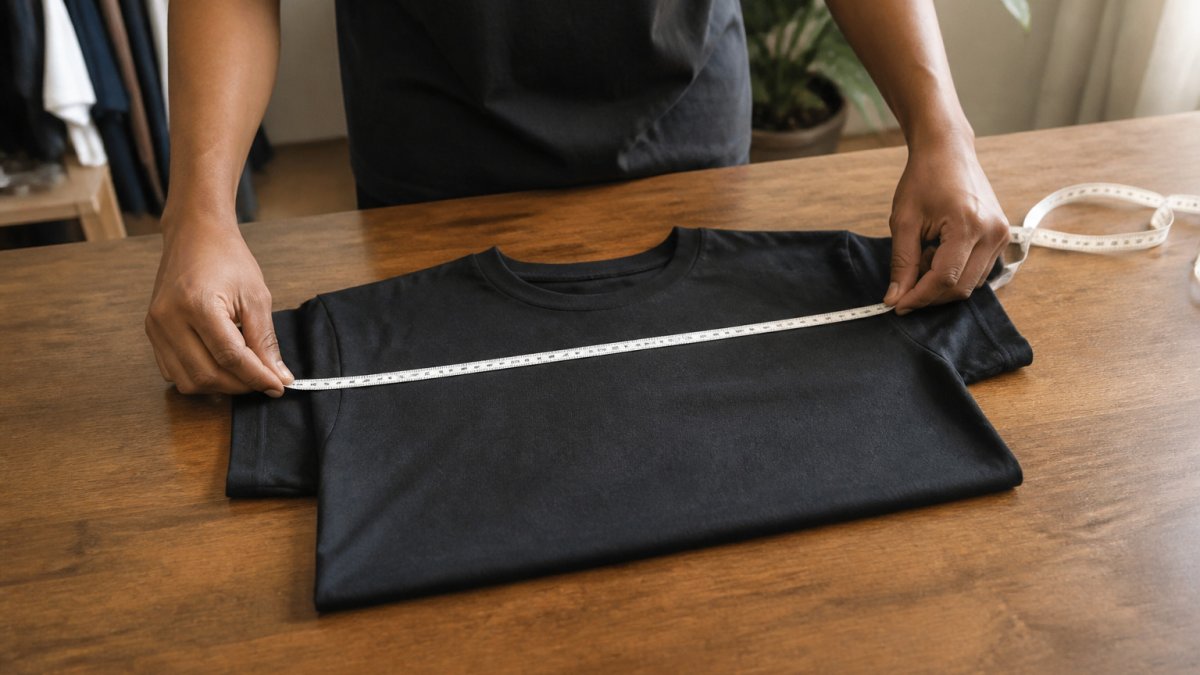
- Chest width: Measure straight across from armpit seam to armpit seam, then double the number.
- Body length: Measure from the highest point of the shoulder, next to the collar, straight down to the hem.
- Sleeve length: Measure from the shoulder seam to the end of the sleeve.
Compare these numbers with the size chart of the brand you are considering. This method works well because it measures the actual garment, not the label.
Common mistake: Measuring a stretched tee while it is hanging. Lay it flat, with no stretching, so the numbers are accurate.
How to Choose an Oversized Clothing Size
Oversized streetwear is designed to look loose, so your normal size can be the wrong choice. The trick is to stop thinking in letter sizes and start thinking in garment measurements plus intended silhouette. Here is how to decide for each piece type.
Know which measurement drives the look
For an oversized tee or hoodie, the chest width and shoulder width decide whether the piece drapes or looks like you borrowed it. For pants, the rise and leg opening decide whether the cut reads relaxed or sloppy. Check those columns first, not the body length alone.
- Chest width: Lay your best-fitting tee flat and measure armpit to armpit, then double it. Compare that number with the chart's chest width. A difference of 5-10 cm gives a relaxed drape; 10-15 cm gives a clearly oversized look; beyond that, the shoulders will likely drop past your natural shoulder line.
- Shoulder width: Measure seam to seam across the back of a tee you like. If the chart's shoulder width is wider than your body's shoulder measurement, the seam will sit down your arm, that is the dropped-shoulder look. If you dislike it, choose a regular-fit piece instead.
- Body length: An oversized tee is usually longer as well as wider. Check the hem position against a tee you own; a jump of more than 5 cm often changes the proportion enough to matter.
Match the cut to the garment type
- Tees: Boxy cuts are wide and short; oversized cuts are wide and long. Decide which you want before sizing. A boxy tee in your usual size may already look oversized.
- Hoodies: Heavyweight fleece holds its shape, so an oversized hoodie stays oversized after washing. Check the chest width and sleeve length; a size up adds length to the sleeve as well as the body.
- Pants: Relaxed and baggy cuts differ mainly in the leg opening and rise. Measure the thigh and leg opening of a pair you already like and compare them with the chart rather than relying on the waist number alone.
- Outerwear: If you plan to layer a hoodie underneath, size for the layered chest measurement, not your bare chest. Add roughly the thickness of the hoodie to your chest number before comparing.
Decide between two sizes
If your measurements fall between two rows, use the intended look as the tiebreaker:
- Want the intended drape? Choose the size whose chest width is closest to your own chest measurement plus the drape allowance above.
- Want a cleaner line? Choose the smaller size, but check that the shoulder seam still sits where you want it.
- Layering? Choose the larger size and confirm the body length does not swamp you.
Oversized pieces look best with a clear, intentional silhouette. Pair a loose tee with slimmer trousers or shorts for balance.
Oversized streetwear is cut to look loose, so compare the garment's flat measurements with your own rather than relying on the letter size.
| Measurement | What it controls | Rule of thumb |
|---|---|---|
| Chest width | Drape of the body | 5-10 cm larger: relaxed drape |
| Chest width | Drape of the body | 10-15 cm larger: clearly oversized |
| Shoulder width | Dropped-shoulder look | Wider than your shoulder: seam sits down your arm |
| Body length | Proportion | Over 5 cm longer: changes the look |
| Chest over a hoodie | Layering room | Add the hoodie's thickness to your chest number |
Between-Size Decisions, Shrinkage and Fabric Stretch
Sometimes your measurements fall between two sizes. Use these rules, then adjust for the fabric and construction of the specific piece.
Between-size rules
- Choose the larger size if you want comfort, layering room or an oversized look.
- Choose the smaller size if you want a closer, more fitted line, but check the shoulder seam and sleeve length first, because those are the hardest to alter.
- Check the fabric weight. A heavyweight cotton or cotton-poly blend holds its shape and will not grow much. A lighter, stretchy jersey can relax with wear and may end up closer to the larger size after a few washes.
- Check the construction. Ribbed cuffs and hems pull a garment in; a raw or open hem lets it hang looser. Drop shoulders add apparent width without adding chest room.
Plan for shrinkage
The practical rule is to follow the care label, since fabrics can shrink with heat.
- Cold wash, inside out. Heat is what drives shrinkage and fades prints.
- Avoid the dryer where the label allows. Air-drying keeps the garment closer to its original measurements.
- Check the care label before you buy if the fit is critical. A piece that must be tumble-dried will behave differently from one that can be line-dried.
Measure the garment, not just yourself
The most reliable between-size check is to measure a garment you already own that fits the way you want, then compare its flat measurements with the chart. Measure chest width, body length, shoulder and sleeve on a flat surface, with no stretching. If the chart's numbers sit between your two candidate sizes, choose the one closer to your target garment rather than to your body measurement.
Account for fabric stretch
When ordering from an overseas seller, also convert the chart's units, many list centimetres while your tape may be in inches, before you compare.
Checking Your Measurements Before You Order From 404Wear
Once you have your numbers, compare them with the product's size chart. Our ONECOLOUR tee is a good example. It is cut oversized only, comes in S, M, L and XL, and is made from a 220 gsm cotton-poly blend. Check its chest width and body length against your own measurements before you choose a size.

Our ONECOLOUR tee is priced at LKR 1,990.00, and our other graphic tees are priced from LKR 3,800.00. Keep your measurements handy when you shop, and follow the care label to keep the fit and print in good shape.
Frequently Asked Questions
How do I determine my clothing size?
Start with your chest or bust, waist and hip measurements taken with a soft tape while wearing light clothing. Compare each figure with the brand's size chart rather than relying on the size you usually wear, because labelled sizes differ between brands. If your measurements fall between two sizes, read the chart's fit notes and decide whether you want a closer or looser fit. For streetwear, check whether the brand describes a regular or oversized cut, since that changes which row of the chart applies to you.
Should I size up for an oversized streetwear fit?
Not always. Oversized pieces are cut deliberately wide through the body and sleeves, so many buyers keep their usual size for the intended drape. Check the listing for the garment's chest width and length in centimetres, then compare them with a tee you already own that fits the way you like. If you want a heavier, boxier silhouette, sizing up one step is common, but read the product's measurement table before deciding. 404Wear's ONECOLOUR tee, for example, is sold in oversized fit only, so size against its measurements rather than your usual label.
How can I tell if streetwear runs true to size?
Compare the brand's listed measurements for a garment you already know fits well. If the chest, length and sleeve figures match your favourite piece closely, the brand is likely to run true to size for you. Labels can vary between brands, so one brand's medium may not match another's. Look at customer reviews that mention fit, and keep the return policy in mind before ordering several sizes.
What should I do if I am between two sizes?
Choose the size whose chest and length measurements sit closest to your own, then decide based on the fit you want. If you prefer a relaxed, streetwear drape, pick the larger size; if you want a close fit, pick the smaller one. Measure a garment you already own that fits well to make the decision more reliable.


